

Technology of SKE
Supporting Ultra-Fine Patterns
As flat-panel displays continue to increase in size and image quality, photomasks are also becoming larger and more precise. Today, manufacturers are required to form extremely fine patterns with line widths of several micrometers (μm; 1 μm = 1/1,000 mm) on glass substrates larger than one meter square.Leveraging proprietary writing and process technologies, SK-Electronics can form high-resolution patterns within an extremely small error range at submicron levels.
We also apply these technologies beyond flat-panel displays and, in response to customer requirements, provide the highest-quality photomasks for a wide range of electronic device applications.
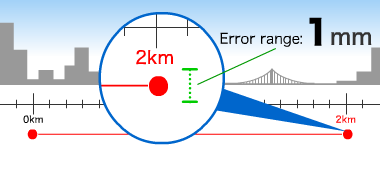
SK-Electronics can write photomask patterns in straight lines while keeping deviations within a submicron error range. This level of precision is comparable to drawing a line approximately 2 km long while limiting lateral deviation to within 1 mm from start to finish.
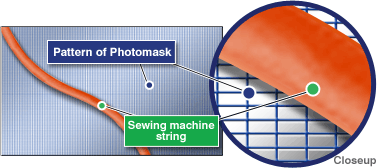
A typical sewing thread has a diameter of about 0.2 mm. In comparison, the patterns formed on photomasks are extraordinarily fine.
Improving Resolution with Phase Shift Masks (PSM)
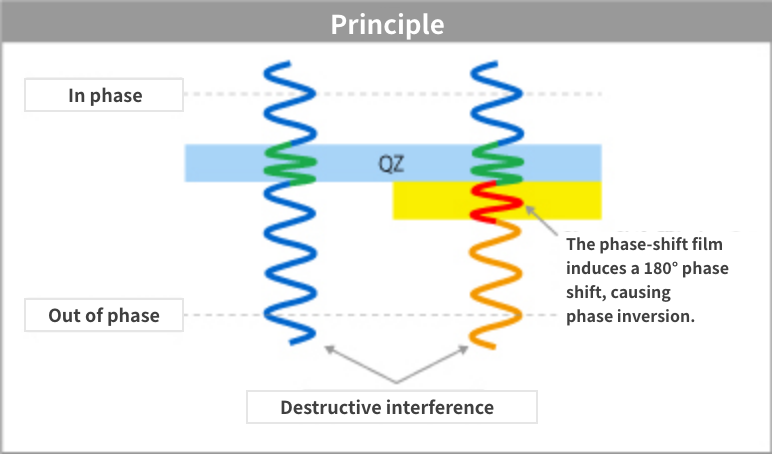
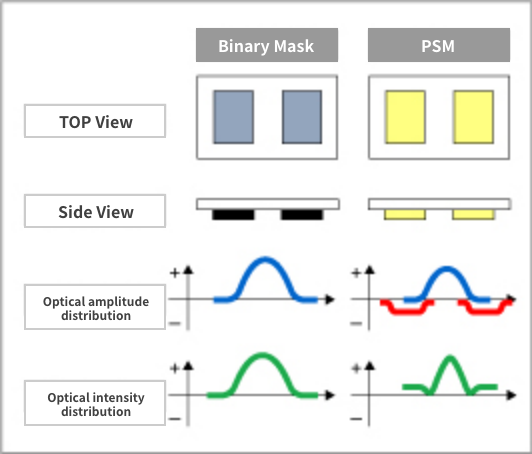
A Phase Shift Mask (PSM) is a technology that improves resolution by adding a phase-shift film to portions of the substrate. Because the added film has different refractive index and transmittance characteristics, it changes the phase and intensity of the light passing through those areas, increasing intensity contrast at pattern boundaries and thereby improving resolution.
Pattern-edge intensity contrast is improved, resulting in higher resolution.
Multi-Tone Masks that Improve Production Efficiency and Panel Quality
Multi-tone masks can transfer patterns onto a substrate with fewer masks than conventional processes, helping shorten the panel manufacturing process and improve production efficiency.
They also enable the expression of intermediate tones, thereby enhancing display quality. Going forward, SK-Electronics will continue to leverage multi-tone mask technology for other displays and electronic devices as well, in line with customer needs.
What Is a Multi-Tone Mask?
There are two types of multi-tone masks: gray-tone masks and half-tone masks. Gray-tone masks create slits that are finer than the resolution of the exposure tool; these slits partially block the light to achieve intermediate exposure. Half-tone masks, on the other hand, use a semi-transparent film to achieve intermediate exposure.
Both types can produce three exposure levels in a single exposure step—exposed areas, intermediate-exposure areas, and unexposed areas—allowing the development process to form photoresist in two different thicknesses. By utilizing the difference in resist thickness, patterns can be transferred onto panel substrates with fewer masks, improving panel production efficiency.
Gray-tone mask
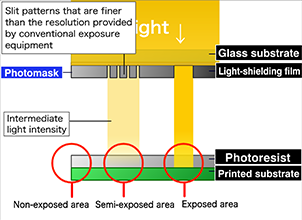
Achieves intermediate exposure by using slits finer than the resolution of the exposure tool to partially block light.
Half-tone mask
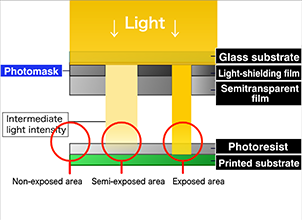
Achieves intermediate exposure by utilizing a semi-transparent film.